- Home
- Galleries
- * GALLERY 4 * Calculations & problem-solving: CMG
- Separating sets, including children's own signs for '='
Separating sets, including children's own signs for '='
Separating sets
Children use a wide range of strategies to show that their two amounts are distinct and separate. They do this in a variety of ways, including:
- Grouping the two sets of items to be added, leaving a space between them,
- Separating theses with words,
- Drawing a vertical line between the sets,
- Drawing an arrow or a personal sign between them.
Equals signs
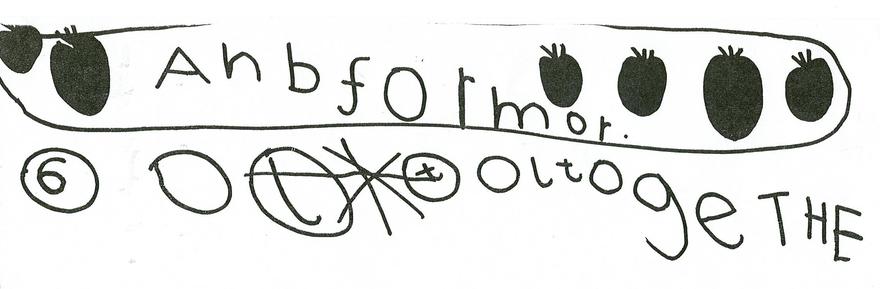
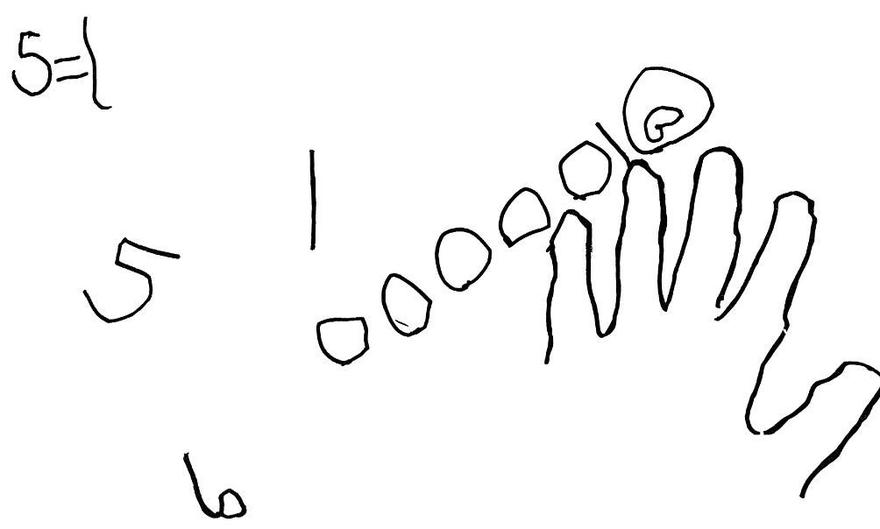
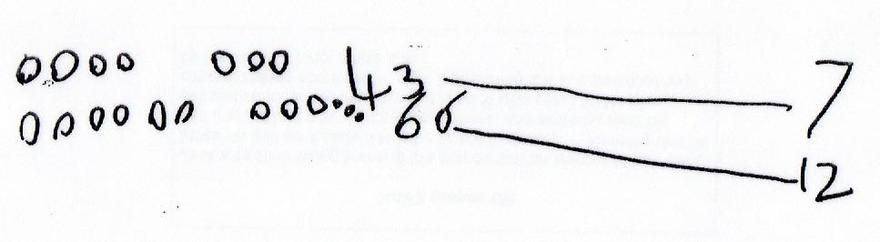
Young children begin by using their own means to signify the equals symbol. For example, Louisa (below) ended her calculations by writing the words "altogether there's '6'" (circled) and John merely wrote "is" before his total, whereas Fred just added the number of their total, without anything to indicate the equal’s symbol. In his calculation, Jack used a horizontal line to signify 'equals'. (These children had been doing a project ton 'fruit').
Louisa's strawberriesLouisa (5 years, 1 month), was adding strawberries. Between her two sets she wrote 'and four more' (as her personal means of an addition symbol), then finally wrote 'altogether there's 6', in place of an equals symbol.
|
|
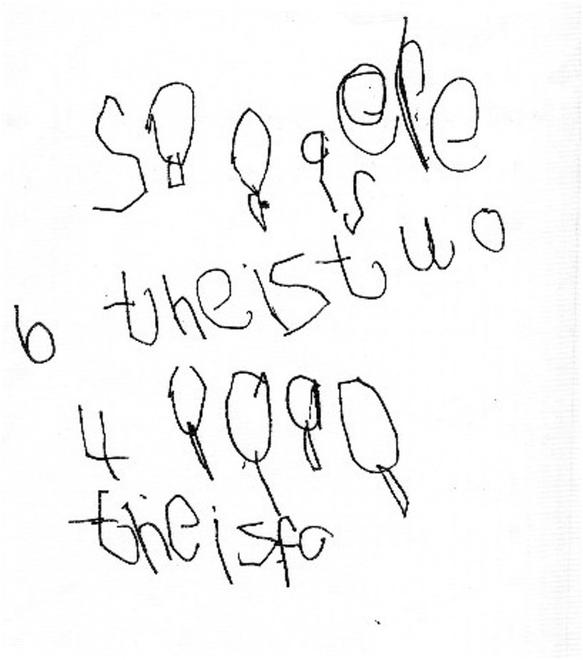 |
Adding grapesIn the same class, John chose to tackle the same problem, mainly writing a written response, '2 grapes, there is two,4 grapes, there is four.' It is interesting to note that John wrote both the numerals and words for both amounts. Finally, he wrote the total '6' (o the left). We have found that young children often choose a written response (i.e., letters or words)
|
Fred adds grapesFred, (5 years, 8 months), was also adding grapes and separated his two sets of grapes with a line (drawn above one finger of the hand). Fred drew a vertical line to separate the two sets. The plus and equals symbols are implied, since the whole can be read as "5 plus1 equals 6." Finally, he wrote the numerals '5' and '1' on' the left, and the '6' beneath as the total.
|
|
|
|
Jack's addition responseJack explored abstract symbols in a different way. He drew two separate sets of grapes, leaving aga that allowed this to be read as '4 and 3', the word 'and' suggesting an addition symbol. Following this, he confirmed the two amounts to be added by writing the numerals, and drawing a horizontal line between these and the final '7' (his answer). The line functioned as an equals symbol for Jack.
|