Our vision
Why children’s own mathematics, and the personal, graphical signs they use to communicate their thinking, are so very important.
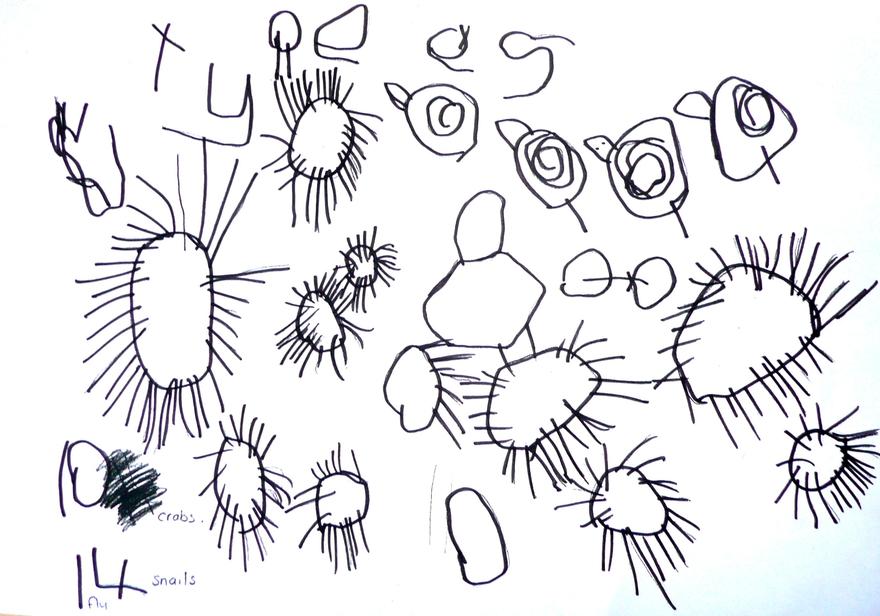 We believe that young children should lead their play and have agency, be able to make personal choices and decisions – just as teachers and practitioners should also have agency in their settings. We share a vision of early childhood mathematics in which young children make, explore and communicate their mathematical meanings in personal ways, in contexts that make genuine sense to them. These contexts will often be spontaneous, in open contexts and in free pretend play, and at these times, children may choose to communicate their mathematical thinking through their Mathematical Graphics.
In the foreword to one of our books (2006), John Matthews sums up this deep interest in young children's graphical signs and representations:
Those of us who have devoted our lifetimes attempting to understand the origin and development of expressive representational and symbolic thought in infancy and childhood, and how best to support it, quickly came to realise that the beginnings of linguistic and mathematical thought are embedded in rather commonplace actions and drawings made by the infant and young child [...] developmentally, these beginnings are of the most profound importance. (p. xiii / xiv)
From our own perspective, we find young children's thinking and learning endlessly fascinating. Our aim is to share our research, understandings and excitement and to dispel some myths. Importantly, we want to help teachers and practitioners, students and researchers gain insights into the very significant strengths and understandings of young children’s mathematical thinking and graphical communications, so that young children become confident mathematicians.
Reference
Matthews, J. (2006). Foreword. In Carruthers, E. & Worthington, M. Children's Mathematics: Making Marks, Making Meaning. Sage.