- Home
- Galleries
- * GALLERY 4 * Calculations & problem-solving: CMG
- Peer influences: Subtraction with small numbers
Peer influences: Subtraction with small numbers
|
|
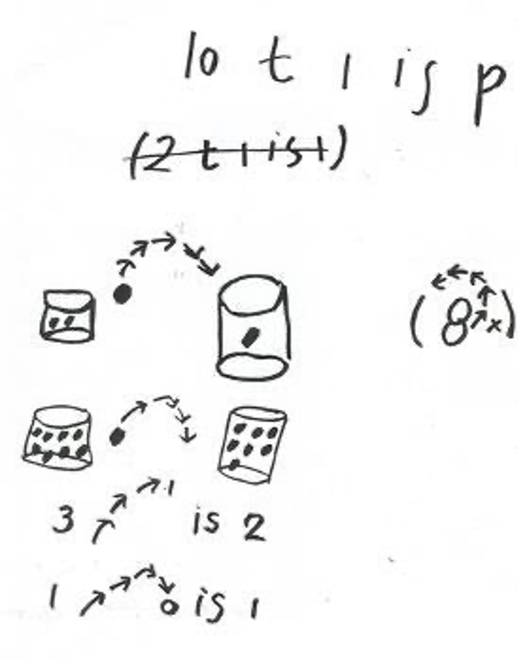
Barney's beansBarney’s class was (in England), Year 1, comprising children of 5 - 6 years of age. The teacher had introduced a game using beans and flowerpots, in which one child counted a quantity of beans as she added them one by one to a flowerpot, and said the final total out loud. Keeping it a secret, her partner then removed one or more beans. The other child had to work out the quantity of beans that remained in the pot, without looking. Their teacher had put some paper and pens on the table, suggesting that they might want to put something down on paper to help their thinking. This was the first time that the children had represented their thinking about subtraction. Barney (5 years, 3 months) began by using a combination of numbers and letters, writing '10 take 1 is 9.' He experimented with drawing arcs of arrows to show the action of removing one bean in his game. At the foot of the page he used numerals rather than beans and flowerpots. Barney was the first child in the class to use arrows to denote 'take away' (something that had never been taught). Finally, he substituted a hand with the numeral '1' written on it to show that his hand had removed one bean. In several of the calculations Barney used the word 'is' to stand for the symbol '='. |
As humans (and also mammals and many other animals), our cultural understandings are socially influenced. Learning is social, and in respect of speech, drawing and writing, such influences are also known as intertextuality.
All of these children are exploring signs and symbols, and in respect of the mathematics involved, these children could work with larger numbers. However, their first endeavours with using graphics to explore subtraction provided important opportunities for them to think about and begin to understand the symbols involved.
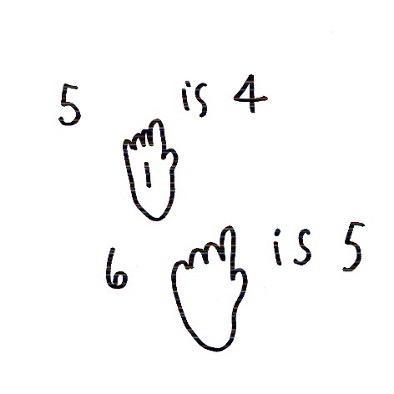
Barney's second thoughtsThis was Barney's second response, combining numerals, a drawing of a hand removing one bean, (signifying 'subtract' or 'takeaway 1'), and he wrote 'is' to signify equals. Barney had omitted to write the numeral '1' on the second hand, but finally he wrote the total '5'. Barney had been sitting with the other members of his group, who quickly saw Barney's arc of arrows and, used their own ideas responded in a variety of ways. |
|
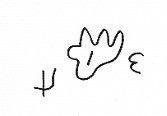 |
AlexAlex also drew a hand to show the operation (the action) of subtraction. |
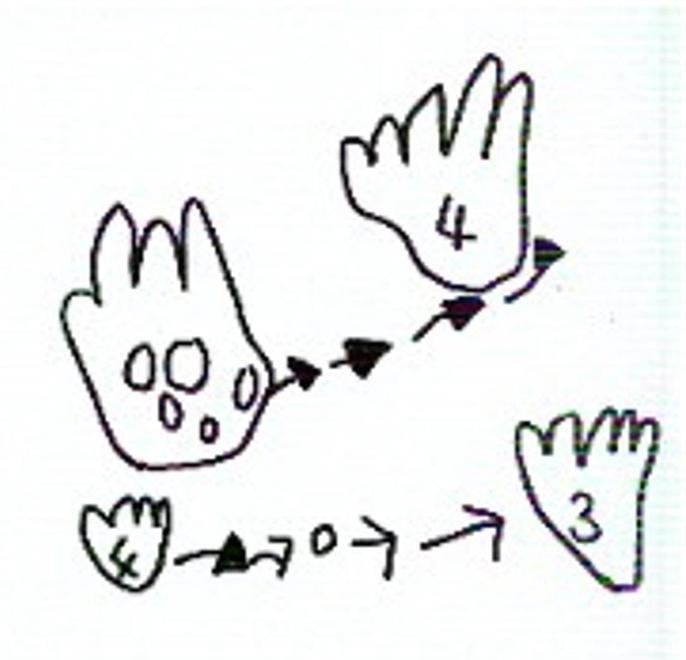
Emma's arrowsIn her first example, Emma represented '5 - 1 = 4' (forgetting to show the 'one' she was subtracting). Building on Barney's idea of arrows to show 'take away', Emma drew arrows pointing towards the final amount, writing her answer '4' on the second hand. |
|
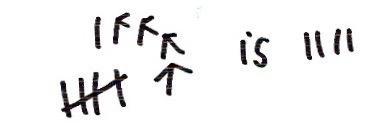 |
Kristian's arrowsUsing arrows in similar way to Barney, Kristian's arc of arrows points to '1' (bean). Kristian used tallies to represent the two quantities of beans, 'is' denoting 'equals'. |
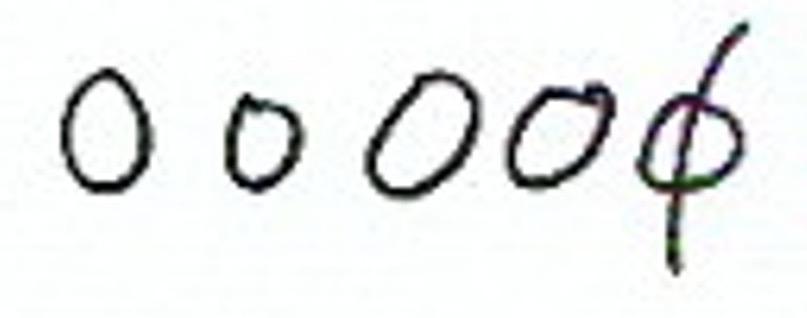
Matthew's beansMatthew rapidly drew five beans, using a line scored though one to signify the one bean that he'd subtracted. |
 |
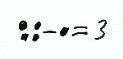 |
Francesca's standard abstract symbolsFrancesca used dots (iconic signs), combined with the standard abstract symbols for 'subtract' and 'equals'. |
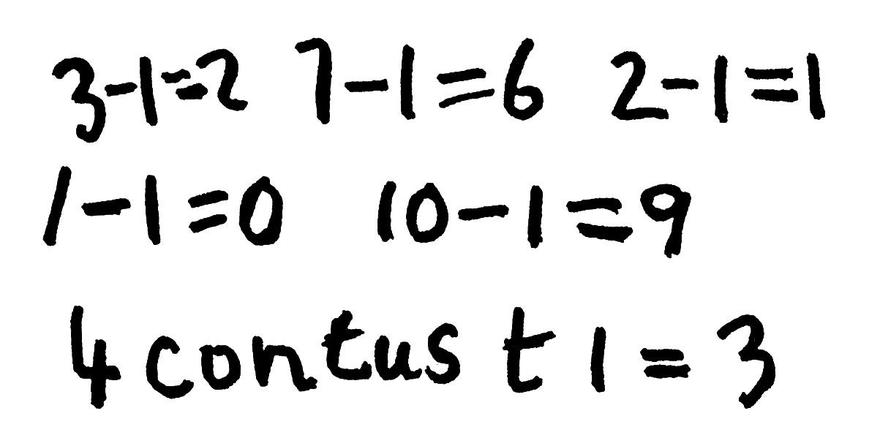
EleanorEleanor chose to represent her calculations in the standard symbolic form (with the exception of her final calculation, which can be read as '4 counters, take1, equals 3' (or '4 - 1 = 3'). |
 |
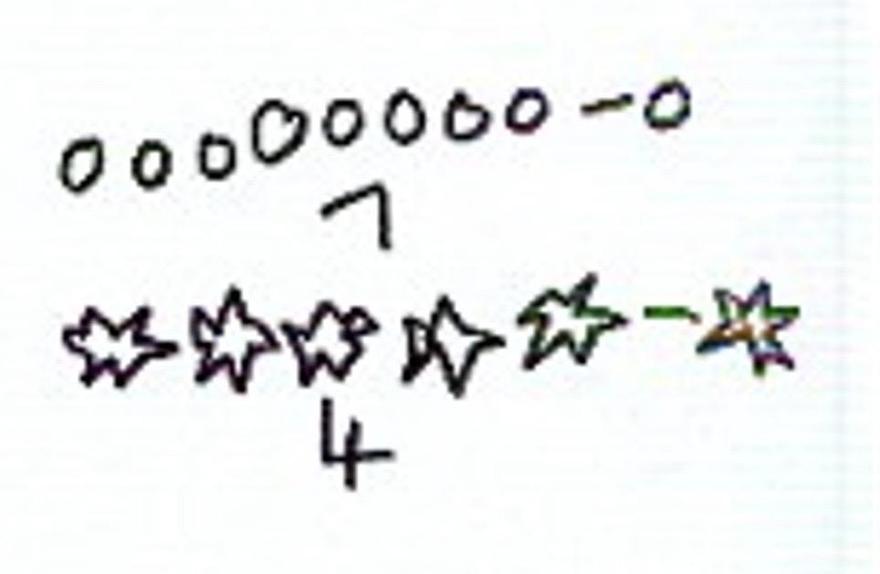 |
Jennifer's ideasTo begin with, Jennifer drew circles or stars (both iconic signs), to represent the quantities of beans in each of the two sets, separating them with the sign for subtraction, (the minus symbol). Finally, she added the total beneath each, using a standard written numeral. |