Versatile signs
Using certain signs to mean different things
Over time, young children develop their repertoires (or lexicons) of graphical signs, drawing on the signs that originate in different contexts of their early drawings, and using them to communicate their ideas through drawing, writing and Children's Mathematical Graphics. In this section we focus on dots, crosses and zigzags.
Dots
|
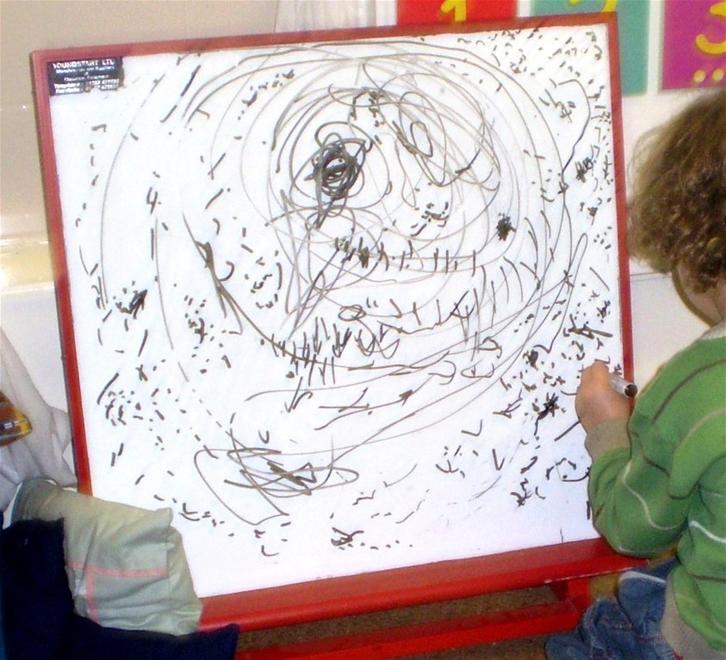
“Hundreds and pounds!”
Charlotte (3 years, 7 months), and her friend Jessica were drawing, each 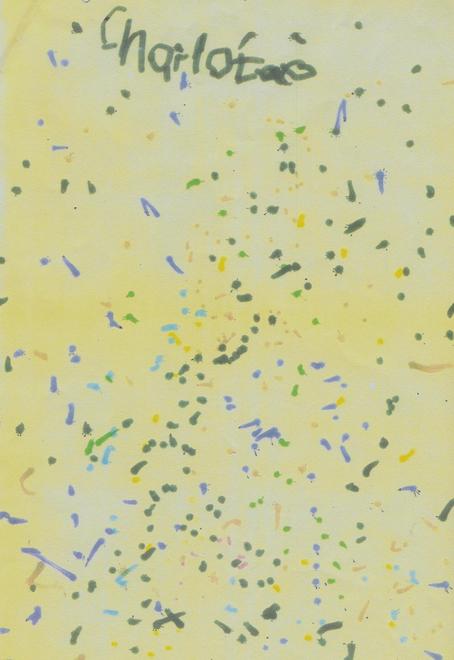 selecting a piece of paper and coloured pens. Charlotte held many pens in one hand, dotting the entire paper as she shouted excitedly, “Hundreds and pounds! Hundreds and pounds!" Her reference to 'hundreds and pounds' meant that she was making connections between the large quantity of dots: this seemed a lot to her, and a hundred fitted in with her thinking about a lot: 'pounds' also fits in with her sense of a large quantity.
|
|
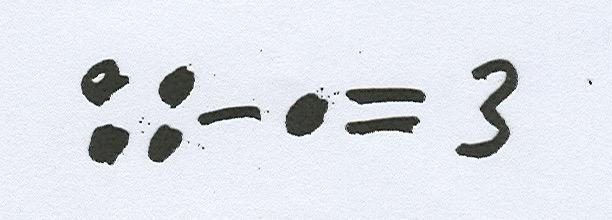
Subtracting beansIn this class of 5–6-year-olds, the children were playing a subtraction game with beans and flower pots. They each chose personal ways to represent what they did, Francesca using dots to represent each bean, whilst at the same time she decided to use a subtraction and an equals symbol. |
Jax adds grapes 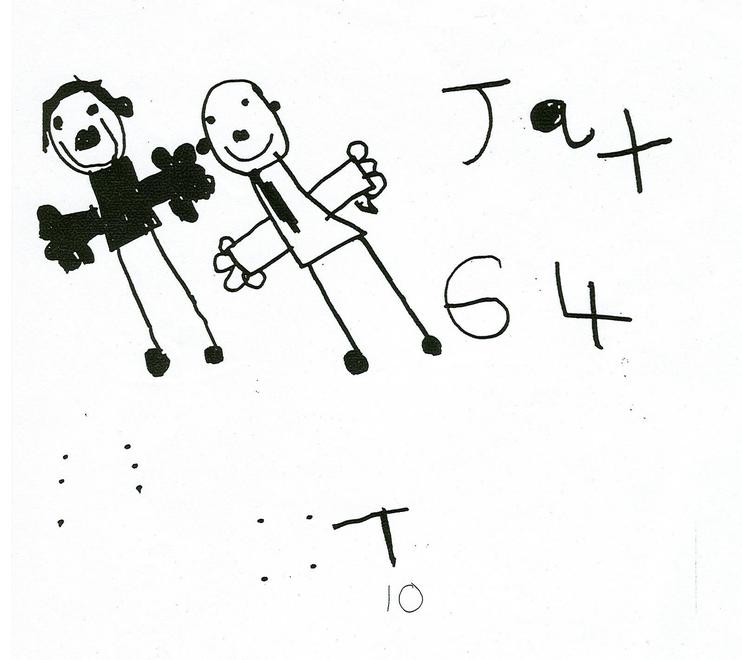
Jax (4 years, 3 months) was adding quantities of grapes. She wrote numerals for the two amounts of grapes, then drew dots to represent them, finally writing the 'T' of the word 'ten'.
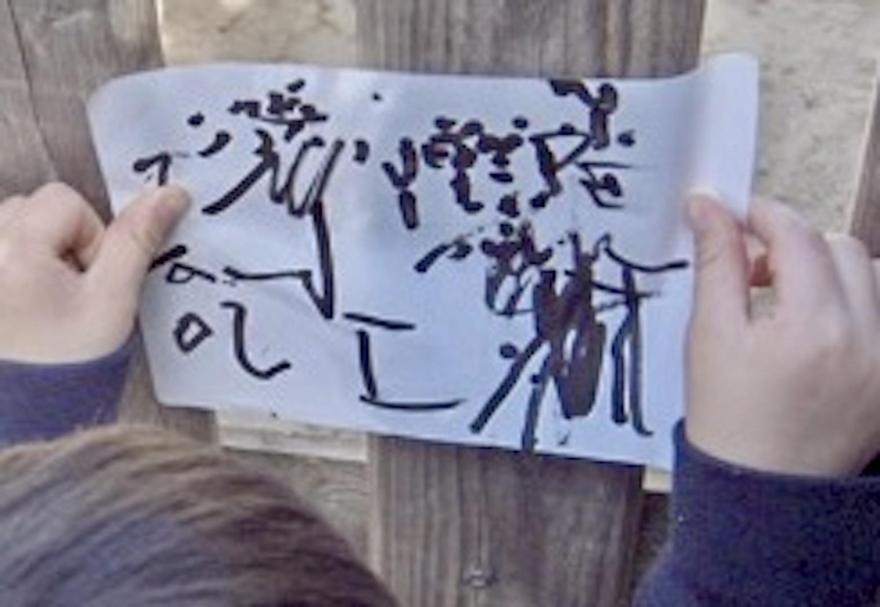
"When there's three ticks you can go ..."Playing “car park entry” with Isaac in the sandpit, Oliver made a sign for the gate. He explained: “These are ticks. When there are three ticks you can go, when there are two you can’t go that way. I’ve made two ticks – that means you are not allowed. People allowed in that way.”
|
 |
Crosses
 |
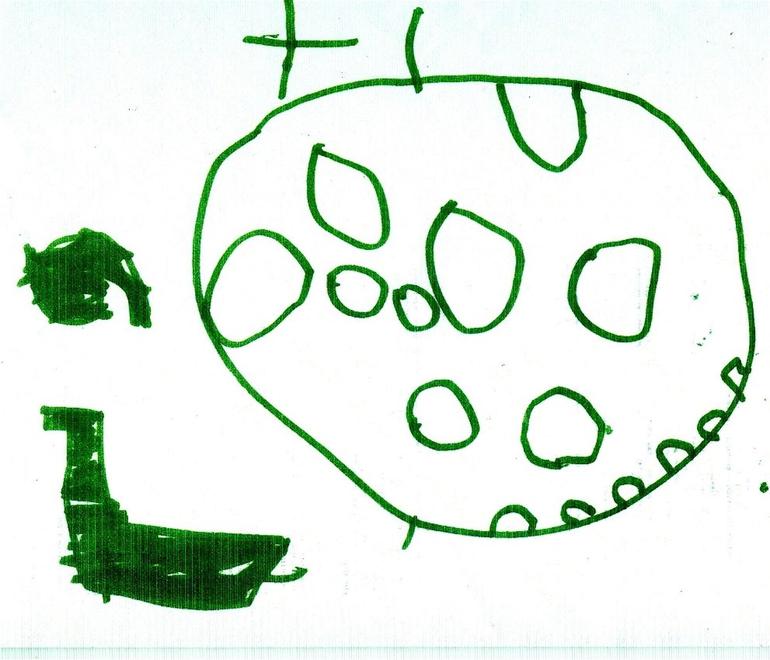
Jazper's gun and "flyer"Jazper (4 years, 11 months) explained: "This is my gun" (in the centre of the page). Then pointing to the 'cross' shape (top right), he added, “And this is my flyer" (aeroplane). Beneath his drawings he wrote a series of letter- or numeral-like signs.
|
|
"A plane flying above the world"
|
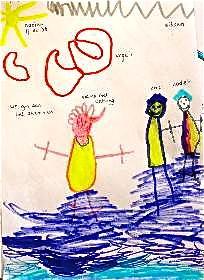 |
Crosses and zigzagsIn the Netherlands, Nadieh (5 years, 7 months) included horseshoe shapes in her drawing to signify "birds flying," birds more often represented in young children's drawings in the west as a 'V', 'M' or 'W'. The people she drew have crosses for hands, and the zigzag at the top represents the sky. Note: compare Nadieh's birds with those that Sterre drew (below) in her drawing herself at the beach (with zigzags). |
Sharing talk about crosses 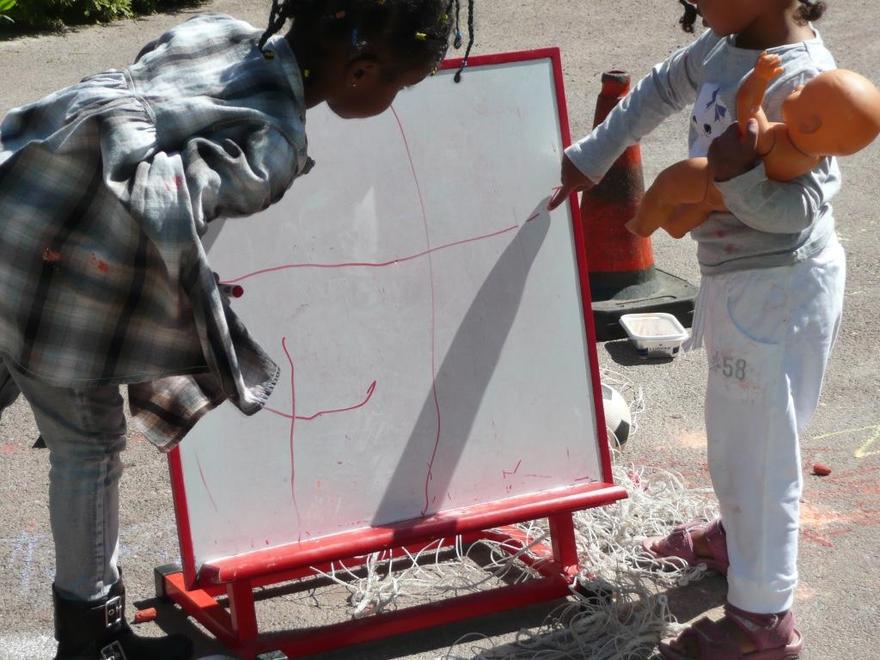
Ayaan (4 years, 9 months) wrote two large crosses on a small whiteboard outside, talking about her symbols with a friend (although what they said is not known). They were both clearly interested in this distinctive symbol, although we cannot know what their intended meaning was.
Shopping
When playing shops, Nathan (4 years, 7 months) chose to write a 'shopping list'. He read his list as "carrots, potatoes and spaghetti." His mother explained that they always wrote a list before the family went to the supermarket. Nathan used crosses to indicate the meanings he wanted to communicate, and drew on his home cultural knowledge in his play at the nursery.
"No! Keep out!" 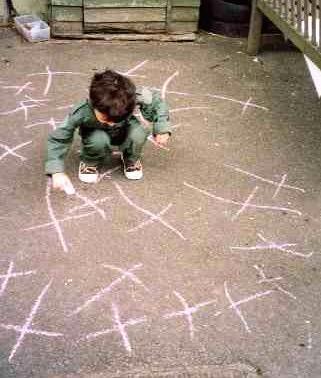
Mark (4 years, 2 months) was playing in the 'garage' area outside, which was enclosed on three sides. He objected that several boys were riding their bikes and wheeled toys into 'his' corner, insisting, "No! Keep out! You can't come here!" Since his verbal request failed to have the desired effect, Mark chose an alternative means to communicate, and fetching a stick of chalk, he drew many large crosses, emphasising his message once more by repeating his verbal instructions. Finally, the other boys 'heard' his message and moved away.
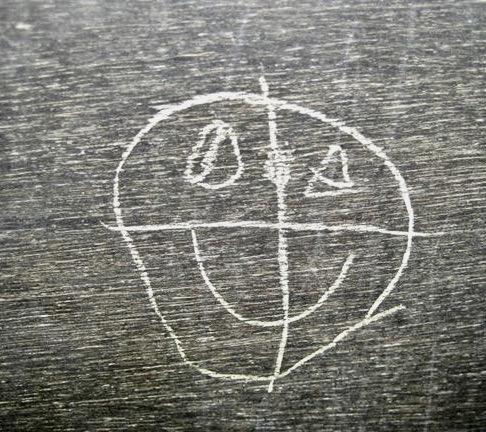 Shop closed
Daniel (4 years, 9 months), had been playing shops and decided to make signs to show when the shop was 'open', and another to show when it was 'closed'. His teacher had noticed what he was doing, and Daniel explained, "It's closed now, the shop is closed.” His teacher asked how people would know it was closed, and pointing to the cross he explained, "Look, here, see? Closed. That means it's closed." Next, he drew another smiling face, but this time without a cross explaining, "Look, that means it's open." Then drawing a cross over the new face remarked, "Oh dear ... it's closed."
The dice game 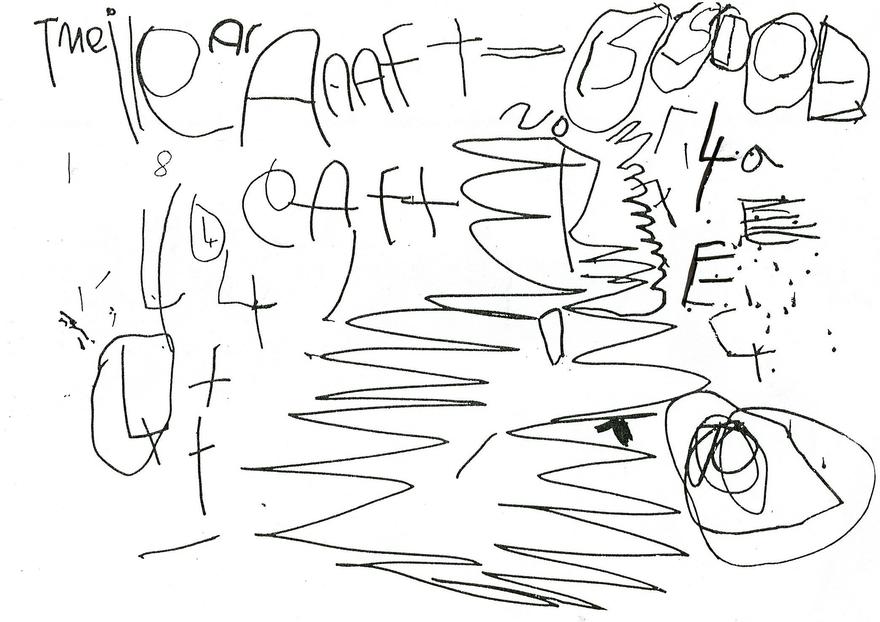
In this mixed-age class of 4–6-year-olds, a group of children were playing a dice game, playing in pairs and rolling two dice together. This provided an opportunity for them to represent the number of dots they got each time, (on one dice, or the total of two combined) – if they chose. Amelie (4 years, 1 month), played this game, during her third week at school. She counted the dots out loud and was very animated as she read the 'e' as an '8', and clearly knew the '4' of her age. She used a combination of marks, iconic signs and standard symbols, 'plus' and equals symbols and some standard numerals with boxes around them. Since her teacher had not modelled boxes around numerals it seems likely that Amelie may have copied from her peers.
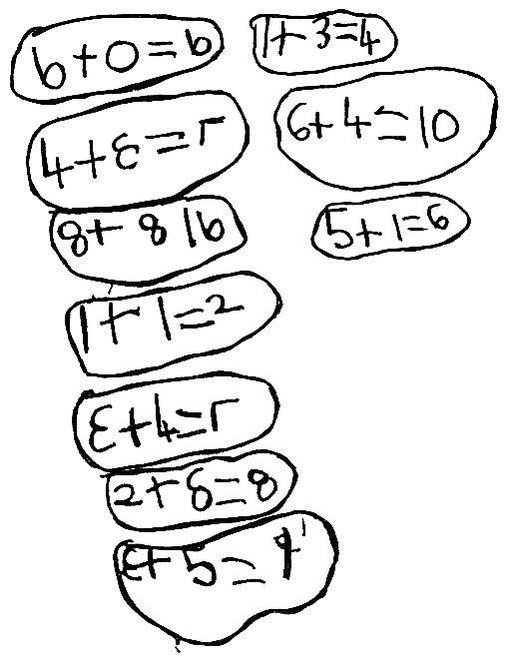 Adding the dots in a dice game
Anna (6 years, 3 months), was a good deal older than Amelie and also played the dice game. She chose to represent her calculations (of the total number of dots on the two dice), in the standard symbolic form. Whilst Amelie had represented the dots in a highly personal (unschooled) way, Anna used standard numerals, and addition and equals signs. She chose to draw a box around each calculation, a feature she had copied from her peers.
Zigzags
Shadow of the flags
|
In the Netherlands, Sterre (5 years, 3 months), named the triangles at the top of the page as "flags", and those she cut with pinking shears at the foot of the page as a, "shadow of the flags." She used zigzags to represent the water (or waves) and "beach shoes", adding short zigzags (like a letter 'M') to represent birds in flight.
|
 |
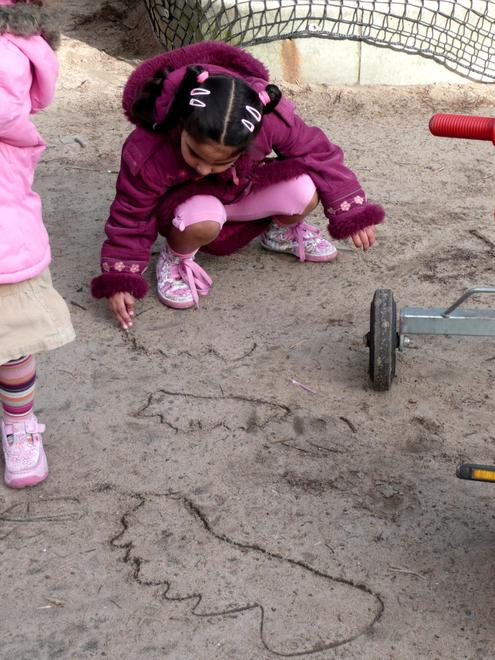 Boat-on-water
In Amsterdam, Aman (4 years, 7 months) used a stick she had found, to draw 'boats' in the sand outside, and completed each with a wavy (or zigzag) line, explaining that this was "water. By combining the curved line of the boat's hull with the wavy line, it appeared that Aman's intended meaning of 'boat-on-water': rather than combining two words, she combined two graphical signs to communicate her meaning.
Romy's staircase 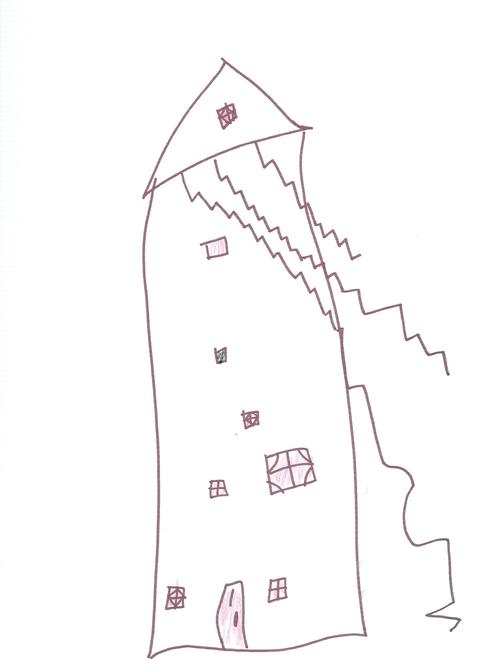
In the Netherlands, Romy (5 years, 5 months) drew a house, drawing several zigzag lines outside her house that suggested staircases.
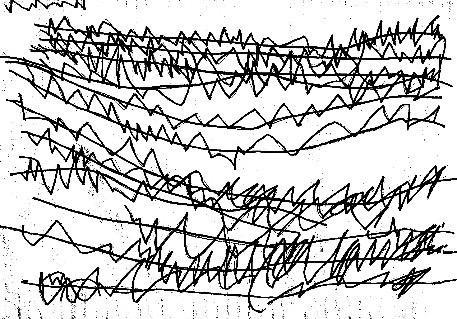
Writing, and a caterpillar cake
On one side of a piece of paper, Nathan (4 years, 4 months), drew a horizontal line with zigzags over it, (not shown), explaining that it was his "birthday cake." His mum had made a caterpillar-shaped cake for his fourth birthday party, the day before. Turning his paper, he repeated the same lines and zigzags, now referring to them as "writing."
Molly's birthday card 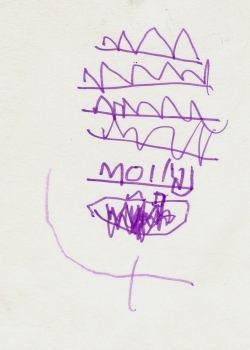
Molly made herself a birthday card, her zigzag 'writing' saying “Happy Birthday" followed by her name, and beneath it she wrote a number '4' for her age.