- Home
- Research and Publications
- Current research - South Australia
- South Australia: MEASURES 2 - Maps and plans
South Australia: MEASURES 2 - Maps and plans
Children’s maps and plans contain many elements of measurement, and since the children in this project often chose to make maps, we have included them here.
Categories of marks and signs
Taxonomy
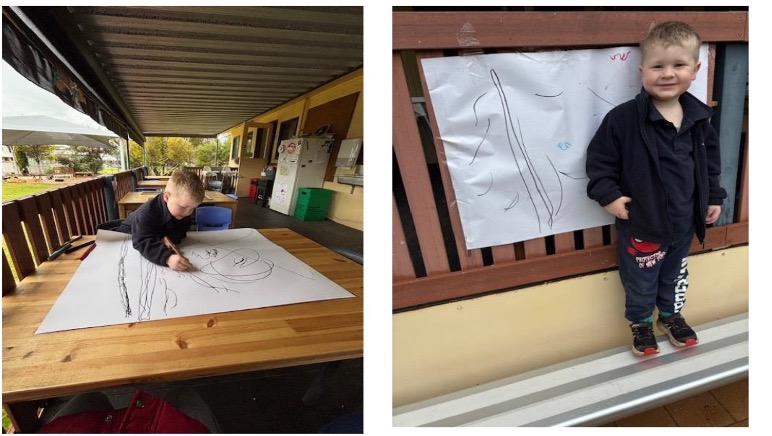
"The street is flooding!"After a weekend of rain, lots of the path was covered in a giant puddle. Andy made a sign that said: “Warning! Stay on the main street. The street is flooding. The three lines means you’re drawing a sign – it says “Don’t go in the main street.’” Andy explained the colours on his sign: “Green means go on that direction, not that direction (pointing to outdoor areas). Blue means you can go straight or go around the slide. Black means don’t go on the main street. Orange means don’t go on the main street.” The taxonomy: iconic – drawing: indexical - pointing The maths: number; direction |
 |
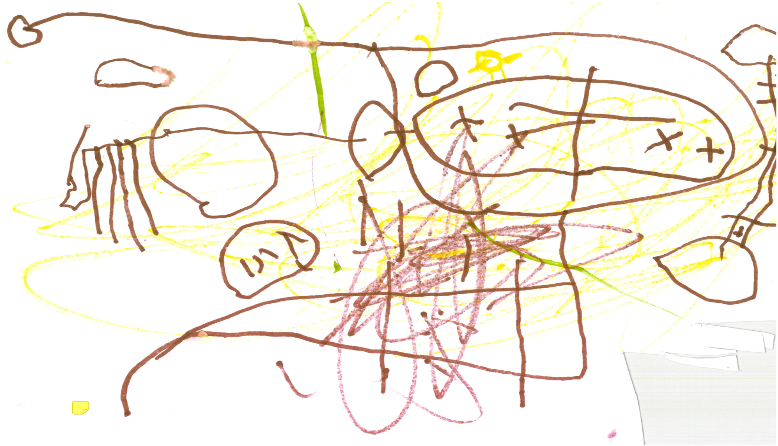
Humour and mathematicsTim (4 years, 4 months) and Henry were engaged in the making area. The educator noticed Tim drawing a map and having a discussion with Henry about it. Henry asked Tim, “Where does the boat reverse in?” and pointing, Tim explained, “The boats can go here (drawing a circle), then a boat can go here, here and here (drew 3 lines in the circle).” Henry pointed to one of the lines and asked “Will that be my boat?” Tim replied, ‘Yea, that can be your boat (points to one of the lines) and that can be my boat” (pointing to another line). “A-n-n-n-d who’s that boat?” (pointing to the third line). Henry said, “That can be my Pa’s.” and Tim added, “No, my dad’s! Yea?” Henry: “Yea, then draw my Pa’s, and you draw your Poppy’s.” While Henry was talking, Tim drew another line in the circle representing a fourth boat. Tim: “I don’t have a Poppy!’” Then Henry pointed to a small rectangle on the left side of the paper and said ‘No, this is my Pa’s house.’ Tim pointed to a previously drawn circle on the right side of the paper and said, “No, this is my dad’s house. We all live in the house and Grandma and Pop live there” (pointing back at the small rectangle). Henry asked, “Do they need to have a boat?” and Tim replied, “No, they actually have a caravan” (drawing a line next to the rectangle), then drew a second line, laughing, “Two caravans they have! Now draw some dirt there” (points next to the caravan lines). Tim was amused by this, and giggling replied, “Actually, 3 caravans (laughing as he drew another line). Actually 4 caravans” (continued giggling as he drew his fourth line, representing a caravan). Henry replied, “Draw 4 boats!!” Then Tim said, “5, 6, 7” and with each number drew another line in the middle of the page. The taxonomy: iconic – drawing; indexical – pointing The maths: distance; position; location; number
|
 |
To the airport via Imagination!Alex (4 years, 11 months) was sitting at the drawing table inside, making some marks. He explained his drawing as “A picture of me drawing”, then finishing it, he approached the educator to talk about it more. “We’re down here (pointing to the bottom of the page) and the educator is up there (Alex drew a line). The X is here (pointing to the bottom X on the page) and we need to get here” (drawing another X at the top of the page). The educator observed, “Oh! It’s a map!” Then Alex explained, “The treasure is here (pointing to where he drew the last X). “The treasure is at the airport.” Then looking to the outside of the Kindy environment, he said, “We need to jump on the trampoline, and then we can go to the airport when we get down.” Alex moved to the outdoor environment holding his map. He had a small group of children with him and used his map in play to look for treasure. The taxonomy: early attachment of meanings to graphical marks; Iconic – crosses; indexical - pointing The maths: position; location; direction |
|
|
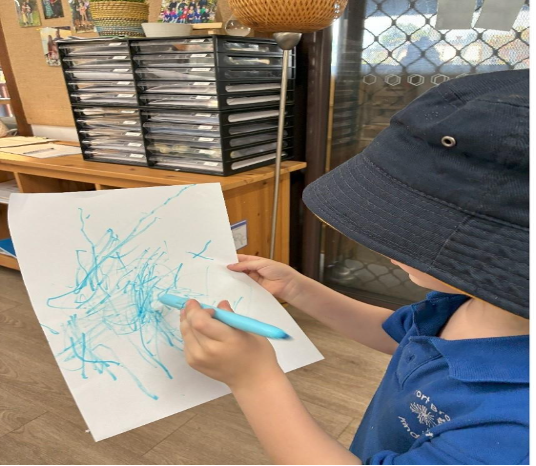
Triple bunk bed!Lilly (5 years, 2 months) shows her what she’s doing, “Look how big it is. There are three beds” and her educator asked how you’d get to the top? Lilly replied, “Here, up the ladder, 1, 2, 3, 4, 5, 6, 7, 8. Now I can sleep at the top, not bottom. You can go up and down the ladder lots.” The taxonomy: iconic – drawing; indexical - pointing The maths: position; location; number |
|
|
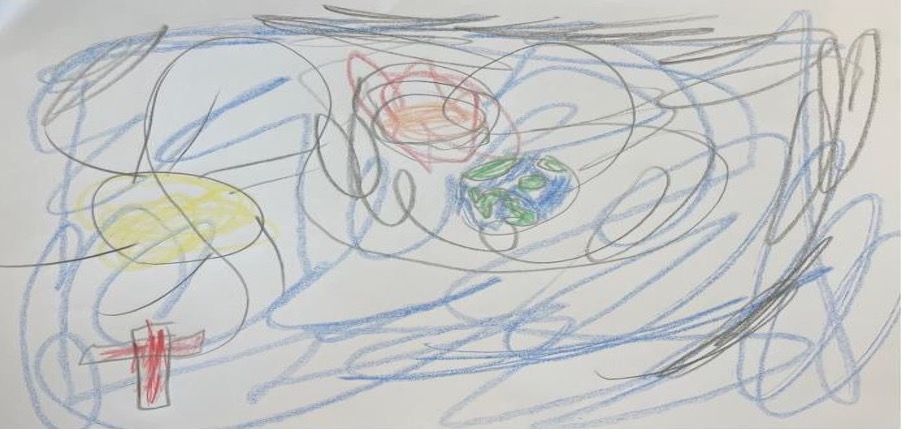
Maggie's space mapThe children had created a pirate ship out of a cardboard box and were using it as a prop for pretend play. One child suggested that they needed to have a treasure map, so a few children created their own versions of treasure maps. Maggie (5 years, 2 months) had been listening to the group talk. Over the past few weeks, she has loved sharing her favourite cartoon ‘The Magic School Bus’ and the adventures that Miss Frizzle has with her students. A recent episode Maggie had shared was around exploring the solar system. Maggie incorporated her knowledge of familiar planets to put a spin on a traditional treasure map. Maggie shared her treasure map and used her finger to follow her directions, telling her peers, “A space pirate might hide treasure on a planet! We have to start here at the Earth. Just follow the line-up and around. Oh, wait, don’t follow the wrong line! That red planet is the first stop. You go around it three times, then it goes kinda crazy and curls around in a round and round pattern. Then you gotta go up high and drop down past the sun. Just under the sun you can find the treasure. X marks the spot!” The taxonomy: iconic – drawing; indexical - pointing The maths: directions, location, position; rotation, quantity |
 |
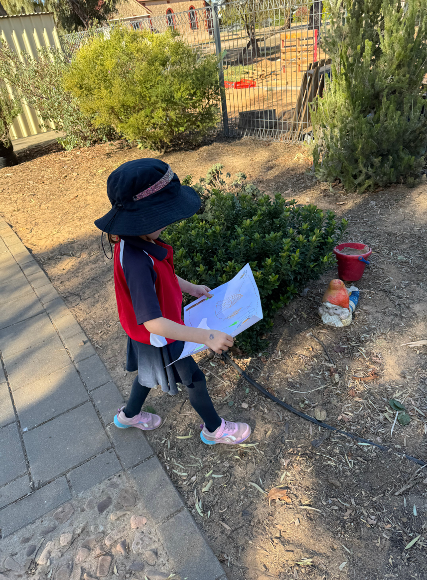
Another treasure mapWinter (4 years, 11 months) decided she wanted to go on a treasure hunt but she needed a treasure map. The educator suggested that they could find the landmarks around the yard and draw them onto her own map. Once Winter finished the treasure map, she asked the educator to hide a bucket of sand on the ‘X marks the spot’ behind a bush, and then Winter used the map to follow the path to the treasure. Then she decided it was her educator’s turn. This time she hid the treasure and her educator followed her map and path to the treasure. Other children were interested in what Winter was doing, and she got someone else to hide the treasure and they repeated the finding process. Winter confidently uses marks and drawing as symbols of communication. Her marks display a high complexity of detail. For example, the colours for the gym mats were the same colour and direction of the mats in the yard. The foam block couch has details including the yellow ends and blue crosses on the back. She is developing an in-depth understanding that symbols are a powerful means of communication, and that ideas, thoughts and concepts can be represented through them. She uses symbols for purpose in play to represent and make meanings. The taxonomy: iconic – drawing; indexical - pointing The maths: directions, location, position, quantity |
|
|
|
|