- Home
- Galleries
- * GALLERY 2 * Categories of graphical marks, signs & symbols
- Other iconic signs: crosses and ticks
Other iconic signs: crosses and ticks
Crosses and ticks
Visually crosses have strong impacts, and are some of the first abstract symbols children use to represent meanings. Young children use the (spoken) language of zero, such as “nothing”, “none left”, “empty”, finding these are dominant aspects of zero, many children using crosses appeared to understand absence or nothing, prior to appreciating that they can represent these concepts by zero, '0'.
|
|
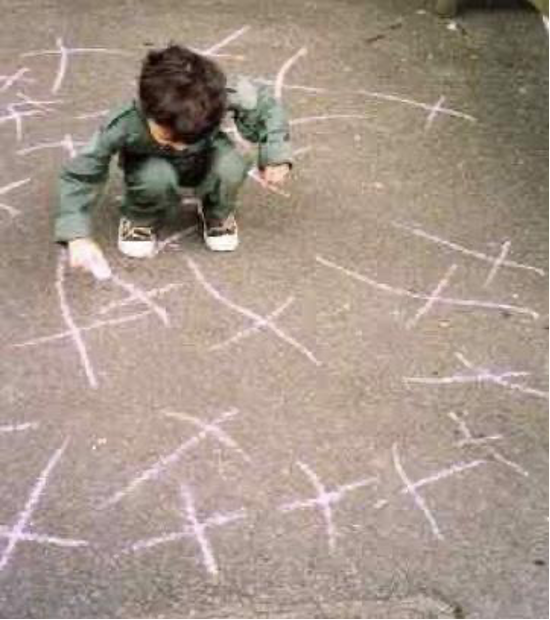
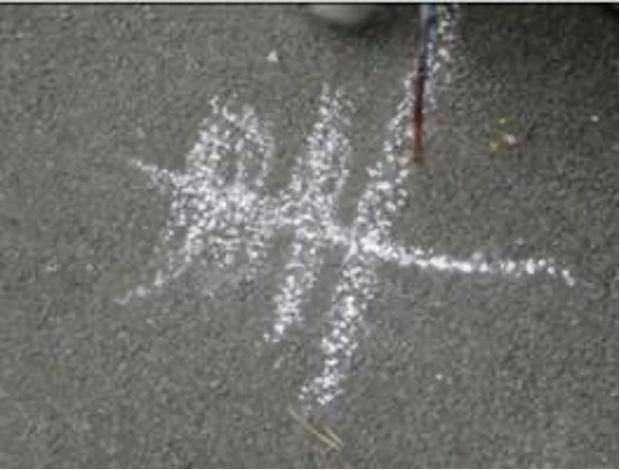
“No! Keep out!”In the ‘garage’ role-play area outside, Mark was playing in an area enclosed on three sides. He objected that a number of boys were riding their bikes and wheeled toys into 'his' corner, insisting,"No! Keep out” You can’t come here!" Since his verbal request failed to have the desired effect Mark chose an alternative means to communicate his message and, fetching a stick of chalk he drew large many large crosses, emphasising his message by repeating his verbal instructions as he drew. Finally, the boys ‘heard’ his request and moved away from where Mark wanted to play.
|
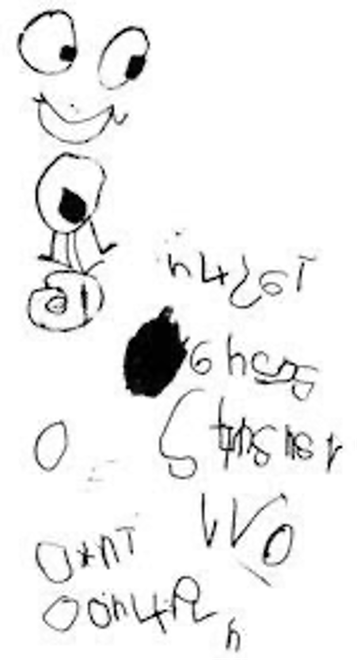
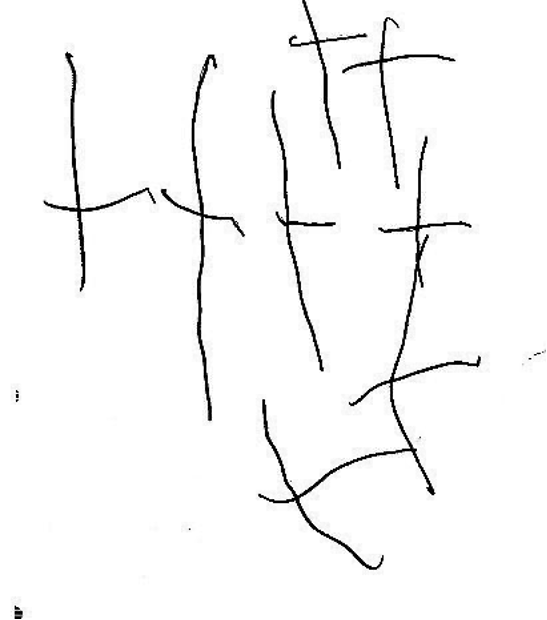
Nathan’s shopping listWhen playing shops, Nathan (4 years, 1 month), decided to write a ‘shopping list’, writing crosses to signify items on his list as “carrots, potatoes and spaghetti." His mother explained that they always wrote a list before the family went to the supermarket, and Nathan had drawn on his home knowledge in his pretend play at nursery.
|
 |
Making ‘Dinner Registers’ (4-year-olds)One day when her teacher called the dinner register, Natasha brought a piece of paper and a pen to make her own. Natasha focused on the concept of a list, and included some ticks and circles as she’d seen her teacher do. Several other children wanted to join in, Gemma using marks with some approximation of circles and crosses (to denote either packed lunches or school dinners), and Alice (4 years, 10 months) represented the children’s responses in two columnsnot shown here], in a way that was easy to check when she’d completed it. Each example shops the child’s current thinking as she used ways of representing to help her think about the data. Their interest on this day led to many other children choosing to make their own registers in their own ways in the following weeks.
|
|
|
|
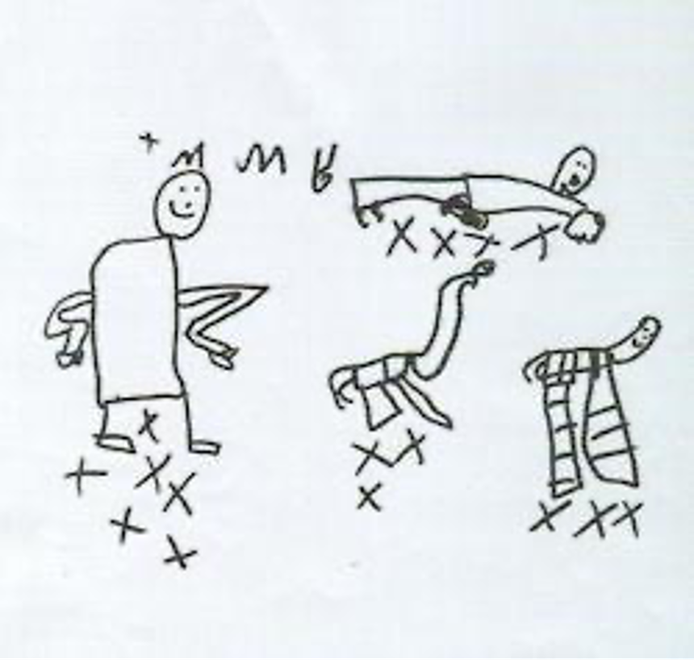
A zoo visitTommy’s class had been on a visit to the zoo and were arguing about which was the ‘best’ animal they'd seen. Tommy (4 years, 7 months) decided to ask his friends, and after he’d drawn a lion, a crocodile, a giraffe and a zebra, took his clipboard to collect his data. The choice of crosses was his idea. Meanwhile, Bianca (4 years, 5 months was thinking about her personal favourites [not shown here], writing her name in the lower right-hand corner to show that she liked lions best, she wrote two other children’s names nearby, using the only remaining blank space other page. For someone else to read what she’s done, the other children’s choices are not clear, but Bianca could recall what they had said. Tommy’s layout allows easier interpretation of the number of choices made by various children for each animal, the cross he’d written beneath each animal making it clear. The children were free to use any means to record their friends’ preferences, and some chose to write individual names, some crosses and others used personal marks or tallies, like Gemma, using the means that best suited their understanding at that time.
|
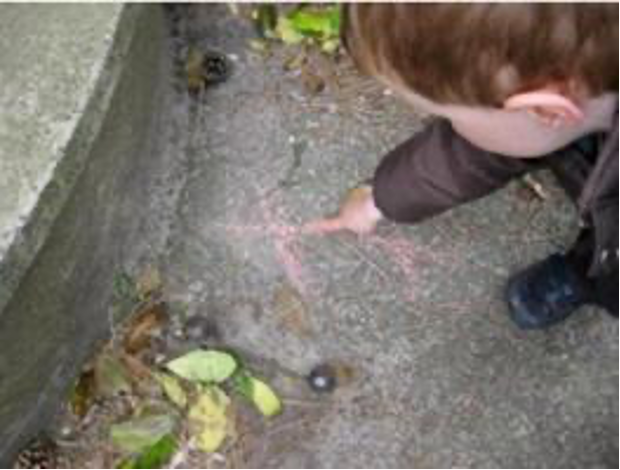
“This means you double lose!”Henry, Joe and Thomas, (4 years, 4 months – 4 years, 7 months) were discussing how many goals they had scored in their ball game. They decided to use some chalks that were outside, making a variety of signs to explain various aspects as they talked about the progress of their game. Henry explained that the single cross “means you lose”, and that the line with multiple horizontal lines drawn across it, “means you double loose!” These are just two of the many graphical signs that the boys generated during the course of their game. These abstract symbols had personal meaning for the children within the context of their game. Their flexible use of symbols also provides powerful understanding of using mathematical symbols
|
|